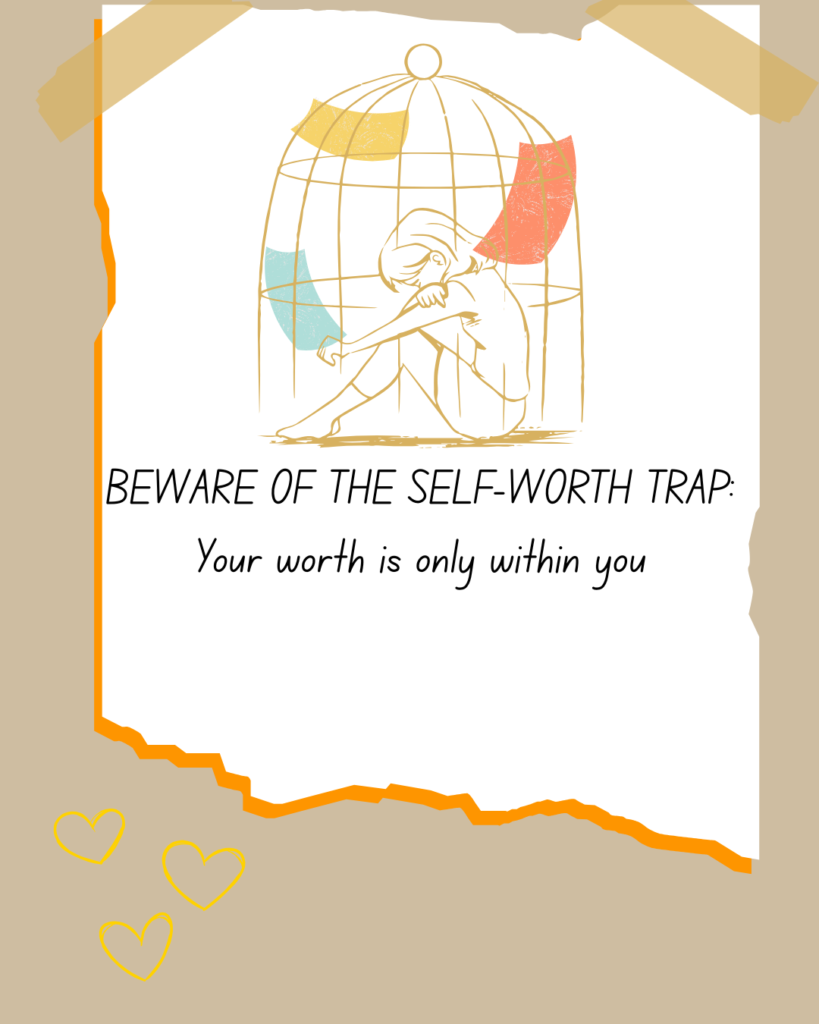
The most dangerous thing our conditioning teaches us is that our worth must be earned or proven. If you are like me, you believed it. My identity and worth were tied to all the external acceptable experiences I was able to accomplish. There was a constant need to proof myself and eventually earn my place in the world. To me worth was only reserved for the socially successful people.
SELF-WORTH TRAP:
This is what they call the self-worth trap. An internalised belief that you are only as good as what you produce, how well you perform, how useful you are, how likeable you are or how well you meet all of the internalised expectations placed on you. At first glance, this mindset appears normal because it is experienced within all our conditioning systems: Society rewards productivity and visible wealth. Families praise achievements. Schools awards numeric output and workplaces too. Relationships often revolve around what each person brings to the table. Even religion idolise their definition of moral perfectionism. So it makes sense that many people internalize this wrong idea filled with different cultural narratives. They do not feel imposed; they feel natural because they are so deeply ingrained that they feel like our own standards now. They masquerade as responsibility, maturity, ambition and etc (you name it). But underneath comes a subtle form of control with the aim to make us work for approval, belonging and safety. This metrics are based on external things and rarely ever grounded on our inner world, which should matter more. The cruelty of the self-worth trap is that no amount of effort ever feels enough and your sense of self remains fragile. What was actually meant to motivate you ends up imprisoning you.
10 common internalized narrative that make up the self-worth trap:
The issue here is not that we lack discipline, ambition, drive or etc; the issue is that our worth has been taken hostage by the over-comparing systems that profit from our endless striving for an external idea of success, and our fears. To see this clearly is the beginning of freedom. Here are the 10 most common internalized narratives:
- Your Achievements
“I am what I accomplish” Your worth rises and falls with your wins. Success feels like relief; failure feels like shame. You don’t just do well, no, you feel you are good only when you perform well.
- Truth: Achievements are meant to be moments of great interest, they show what you did and not who you are. Failing is part of learning; it is not your essence. You can achieve greatly without the self-hate. Give yourself some compassion.
- Your education level
“Prove of intelligence equals worthy” Your worth is tied to formal knowledge, degrees and/or intellectual status. With academic credentials you feel superior yet still inadequate. Learning becomes less about curiosity and more about status.
- Truth: Education shows opportunities and exposure to learning; not intelligence, potential or worth. Learning should be personalized fun that’s both active and engaging, you don’t need to be a walking encyclopaedia or a LinkedIn profile. You can learn without the status anxiety.
- Your number of friends
“My popularity validates my value” Your worth is measures by how many people like you, invite you or are friends with you. Social validation is fuel to you and loneliness feels like proof that something is wrong with you.
- Truth: Connection is about inner depth. It is the quality of friends that really matter not quantity. Those who can co-exist well with your authenticity, growth and truth are the only ones worth keeping around. You can have friends without performing, people-pleasing or self-erasure. Genuineness and respect go a long way.
- Your job
“I am my occupation” Your job becomes your identity, one of the first things people should know about you. You learned that the question “what do you do?” decided how you are treated. If your job is high status in society being unemployed, changing careers or taking a break can make you feel like you are disappearing.
- Truth: A job is a role you play in the economic system not your identity. It is how you can afford to fed, clothe, roof and live. There are many factors that play a part in how you come to have your job and why. You can work or transition without feeling like you are losing or gaining value points.
- Your income
“Money measures my merit” Your worth is tied to the amount of money you make. It ignores privilege, access, systemic inequality and other factors. You may begin to believe that earning more makes you more superior.
- Truth: Earning more may improve your lifestyle but it gives you no character merits (unless you are also good at money management then you get one from me). But you earn without tying money to your dignity. You deserve good things in life too.
- Your past
“I am my mistakes” Your identity to what you once did, rather than who you currently are or even who you are working on becoming. Instead of seeing your past as information, you treat it as your verdict.
- Truth: Your past shaped you maybe even traumatized you, but it does not define you. Growth often proves that you are not who you use to be nor where you use to be. No one is perfect and no one has a perfect past. You did what you did with the knowledge and capacity you had. Don’t beat yourself down rather learn from your past.
- Your social media status
“Online visibility equals value” Likes, views and followers start to feel like proof of existence, proof that you matter, proof that you are doing something right. You perform instead of live. You compare instead of connect. Silence online feels like invisibility. Negative comments destabilize you.
- Truth: Likes, views and followers are works of the algorithm and engagement, not affirmations of your worth. Online visibility is not real validation. Post your content to connect and find your community of people, not to become a God in which others should worship. You can use social media without measuring your soul or needing to perform a lie for us.
- Your materials
“I am what I own” Your worth is tied to brands and aesthetics. You start chasing things not for the joy and comfort, but for status validation. They may feel the same but they are not the same thing, don’t get them confused. One eventually dies out with the applause.
- Truth: Things can be bought and lost; your worth cannot. True identity is not measured by items. Let your materials make you happy, comfortable and fulfilled. Buy what you actually find pleasure in not just what you think will impress other. You can simply enjoy materials from your own true self-expression.
- Your appearance
“Pretty equals valuable” Your worth is tied to the ever-changing beauty standards you did not create. You begin to believe your physical appearance must be acceptable before you are. Aging, weight change or illness can feel like losing value and not normal life changes.
- Truth: Looks change with time, seasons and throughout life. Your value is not rooted in adhering to the beauty standards. The features are yours, but you are more than your features. You live in your body without self-contempt and change from authenticity not shame. You are the first person who should approve of you or any of your changes.
- Your relationship status
“Being chosen equals worth” Being single may mean something is wrong with you, while being in a relationship proves your value. You may stay in unhealthy relationships just to feel validated.
- Truth: While love from others expand life, real worth begins from within. Being single, dating or married does not change your worth. Choose yourself when a relationship no longer serves your well-being. You can love without the fear of abandonment. You are even able to love not just healthily but fully when you are secure within yourself.
THE COST OF LIVING FROM THE SELF-WORTH TRAP
On the surface, the self-worth trap looks well-functioning. It can produce high achievers, disciplined workers and other successful people. But beneath that appearance lies a deep and cumulative cost that touches your life, sense of self and even threatens your place in the world as you know it. Comparison replaces contentment and envy replaces gratitude. Since your worth is conditional, something starts to collect on the conditions, and the real cost is what it slowly takes from you.
- It costs you your mental health.
When worth is conditional, your mind never rests. You live in a constant background state of evaluation. You unconsciously ask, “Am I doing enough?”, “Am I falling behind?” or “Am I still acceptable?” Your inner voice becomes less like a guide and more like a judge that stresses you out. It breeds chronic anxiety, shame, perfectionism, impostor syndrome, criticism, fear of failure and etc.
- It costs you your physical health.
When your body learns that rest is dangerous and your nervous system believes safety depends on your constant performance, you stay in fight-or-flight mode. This will show up as burnout, chronic fatigue, insomnia, headaches, digestive issues, muscle tension, emotional numbness and etc.
- It cost you your authenticity.
You learn to perform long before you could learn how to properly self-express. You stopped asking, “What do I enjoy or genuinely want?” and start asking, “What will look good on paper?” You traded in your authenticity for approval, for acceptance and for safety. You play a role, suppress your needs, minimize your feelings, have no boundaries, hide parts of yourself and etc.
- It cost you your happiness.
Your happiness is always postponed since you always on the move. You tell yourself, “I will be happy when I graduate” or “I will be happy when I get the job” But those moments never really deliver and you only left feeling more pressure than the last. You become so focused on becoming worthy that you miss your life as it is happening. Because happiness requires your present and you are never truly here.
- It cost you your sense of enoughness.
When your worth is conditional, your life choices are ruled by fear. Because the self-worth trap creates a permanent sense of lack, no matter what you accomplish it never settles. Why? The goalpost gets moved again. You become like a hamster on golden wheel, always chasing the next proof of worth but never arriving. All owing to the fact that you never drew the line of what is enough for you. And eventually, it turns your life into a never-ending audition.
INHERENT WORTH
You do not need to keep auditioning your worth though. Many people intellectually agree with this but emotionally resist it. That resistance usually comes from the conditioning rejecting the new as it always does. But inherent worth redefines everything you know and paves a path for you. At this point it almost sounds too good to be true, right? Inherent worth preaches 2 important things:
- “Your worth is not earned; it is given by existence”. Inherent worth says “You are valuable. Full stop”. This means you matter by virtue of being human; not because of what you do, how well you do it, who approves of you or how much you endure at the cost of your own well-being. This type of worth showcases your steady, compassionate, spacious, honest and aligned inner world. Inherent worth reorganizes itself around your internal safety, values, presence and dignity. It allows you to redefine yourself, your life and find your own definitions of success. Everything flows from worth not towards it therefore you live from it. It is the foundation upon which you build your real self-worth and a life that feels fulfilling not like a followed script. A life that feels peaceful and not chaotic. A life with a you in which you personally approve of.
- “Your worth does not change with circumstances”. Inherent worth transforms your relationship with yourself at the most fundamental level. Your value remains steady whether you are winning, struggling, resting, changing and etc. To live from inherent worth is not to abandon growth, responsibility or ambition. But it is to allow yourself to cherish every part of your unique journey and ask, “What can I learn from this?” Your inner world becomes less about proving yourself and more about understanding yourself for the better and just being. You no longer seek to validate your existence; you seek to share your human experience. You allow yourself to be known. Nothing threatens your sense of self because you prioritize your internal experience. You get to meet life as someone already worthy, walking through a complex and imperfect human journey.
If your worth is inherent then suffering is not required, exhaustion is not proof, harmless self-denial is not noble and over-functioning is not love. You get to decide when enough is enough. You become the authority of your own life rather than a prisoner of your safe expectations.
RECLAIMING YOUR WORTH
Reclaiming your worth is not a one-time decision; it is a gradual unlearning of this conditioning and a return to yourself. I still have to remind myself of my inherent worth in times of pressure or feelings of inadequacy. These are the three steps that helped me begin that process from the inside out:
- Reflect on what you feel determines your worth.
Based on your lived experience what areas do you based your worth on? Most of us did not consciously choose our measures of worth; we inherited them. Reflection helps you uncover these hidden rules of worth we live by and acknowledge the cost. This allows you to see when you are seeking external validation and find the reason why. By doing this you take back the power you have given them. You move from “I am / It is not enough” to “I see why I/ it feel not enough” You cannot free yourself from a trap you cannot see. E.g. You notice that you only feel confident only when you look a certain way = Worth tied to appearance= Social pressure
- Let go of the self-worth shame and guilt.
Shame and guilt are the emotional glue that keeps the self-worth trap in place. Guilt says, “You did something wrong” while shame says, “You are something wrong”. When you view your conditional self-worth through this lens, you remain in the trap. These will keep you constantly striving, performing and overworking at your own expense because you are afraid of being exposed as “not enough.” When you let go, you break the cycle and stop controlling yourself through fear. Practice compassion using “It is okay…” sentences. E.g. “It is okay to look different on different days, my worth is deeper than my appearance”
- Ask yourself, “what actually matters for you?”.
This is the most liberating and radical step. After you see your conditioning and soften your shame or guilt, you begin to rebuild your life around your own values, actual needs and wants, not society’s metrics. You ask yourself, “What feels aligned with who I am?” instead of, “What will make people approve of me?” There is no right answer only your honest one. When you know what actually matters to you, you stop trying to earn or prove your worth. The audition is over because you clock it. This marks the new mindset shift from “Never enough” to “I already am, so what do I want to do from here?” E.g. “I dress for how I feel, not for approval”.
A FRIENDLY NUDGE
In the end, the self-worth trap is not a personal failure but a human conditioning. You are not meant to be constantly improving yourself into worthiness; you are meant to live from it and improve simply for yourself. The idea that we must become better, prettier, smarter, more successful, calmer, or more healed before we are allowed to feel okay with ourselves is absurd. It turns life into a project instead of an experience and treats it like a test instead of a journey. You are not here to polish yourself into permission to exist, you already exist so let your aligned life grow from that truth. And in that remembering, you will find both your peace and power.
THANK YOU FOR STOPING BY!!
Stay beautiful and blessed
🥰😍😍🤭🤔Hmmmm living in the shadow and for the approval of others has really done us bad